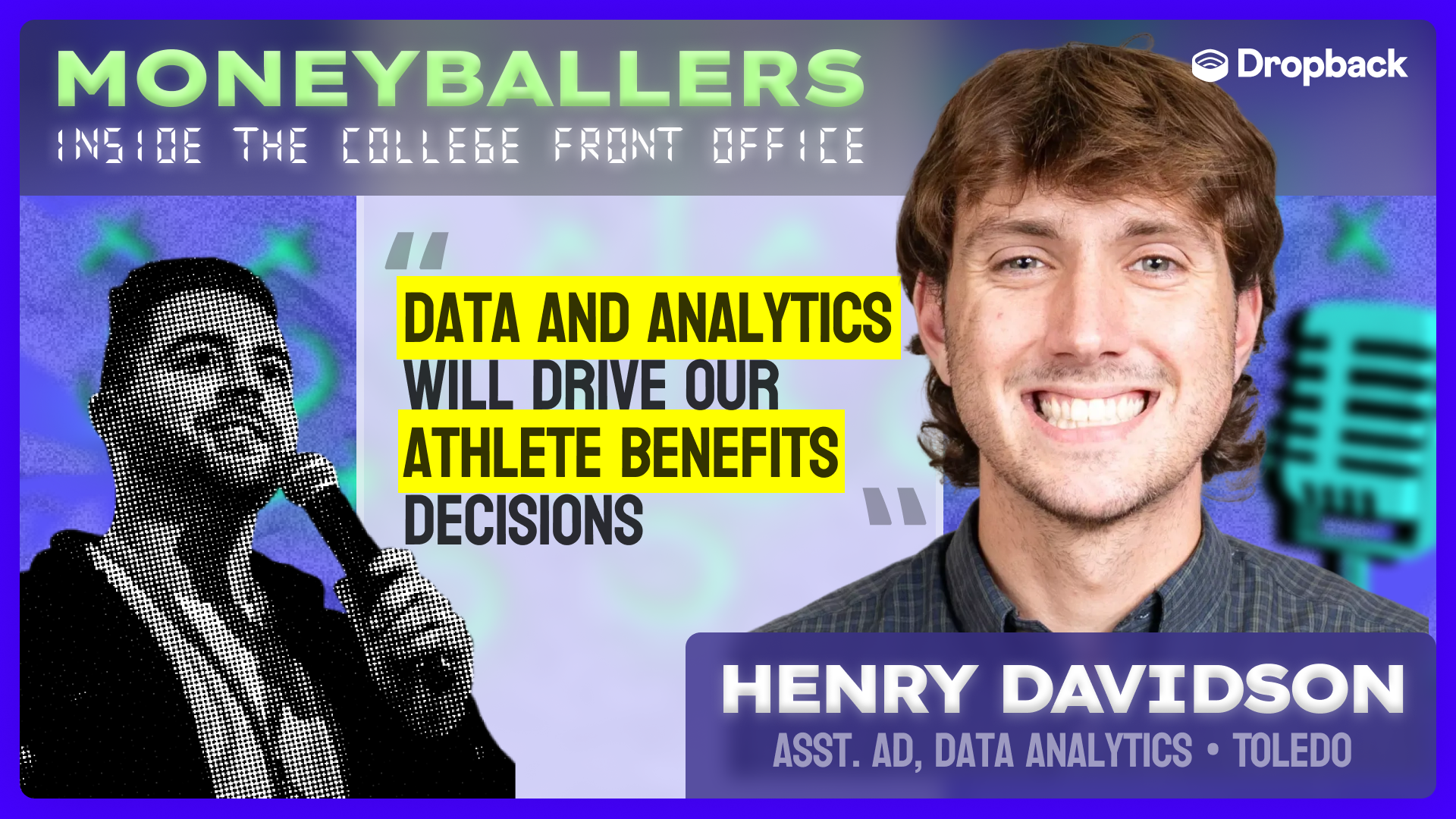



In today's episode of Moneyballers, we're joined by Henry Davidson: the Assistant Athletic Director for Student Athlete Data Analytics at Toledo!
We discuss his role in integrating data analytics into athletic decision-making--even moreso since initial recording due to staff changes! He emphasizes the importance of using data to inform decisions across the entire athletic department: from ticket sales to, of course, student athlete compensation.
Davidson shares insights on collaborating with coaching staff, transitioning from a non-traditional background, and effectively communicating complex data to non-technical stakeholders. He also reflects on future projects and the importance of strategic thinking in the evolving landscape of college athletics.
Our Takeaways
-
Collaboration between data analysts and coaching staff enhances, not replaces, decision-making.
-
Effective communication of data is key for non-technical stakeholders.
-
Understanding the story behind the data helps in decision-making.
-
The future is for those who focus on refining data models and strategies into their decisions.
-
Staying calm and strategic is vital in the face of change.
Transcript
Luke Bogus (00:00) You also have a very interesting title. I'm going read it off. Assistant Athletic Director for Student Athlete Benefits and Data Analytics. Sounds really cool. What does it actually mean? Maybe like walk me through what was the job description like when you applied? What did Toledo bring you in to do?
Henry Davidson (00:12) Yeah, it's a very long title. I like to just refer to myself as the data guy on staff. That's the most simple way to kind of nail it down to just like a couple words without saying my full title. But basically the core thing is it's an intersection of scholarships and rev share and NIL. So it's what is the total compensation package look like for student athletes at Toledo? How can we improve that? How are we making sure our athletes are compensated fairly while
following NCAA rules and stuff like that. And then the data analytics portion, which is kind of cool, is getting away from the sport part. And it's more like ticket sales, revenue growth, operational efficiency. So it bundles all that into one. So I spend probably half my time working with the sports on sports performance, player evaluation, scholarship allocation. And then my other half will be working with the revenue team, marketing team. How do we
drive more engagement on campus, how do we sell more tickets, and how do we just become more efficient as a department in pretty much every area.
Luke Bogus (01:13) Yeah, well, I mean, it's no secret that Toledo is taking a lot of big steps to, you know, make a dent in kind of this new environment.
And one interesting thing that I really appreciate is that rather than just wrapping the former personnel office of the football team into a front office, like just retitling, think like Toledo and the hiring of you like makes an actual statement. Like, Hey, we're going to like do things different in this new era. not that maybe Toledo wasn't using data and analytics to make decisions beforehand. walk me through like, what are some like easy win projects that you've had in the first six weeks of being on the job? Clearly you can stay high level, but are there anything that's like generally interesting that you've already dove it in and been able to
an impact on in your first couple weeks.
Henry Davidson (01:49) Yeah, a lot of it is just like we have the data, it's here. Everything we need is available somewhere, but there was a need for a person to kind of centralize all that and then compile the data into dashboards or ways that people can see it and better understand it. So like, for example, I've already been working closely with the ticket operations team on like, how do we communicate with the AD and with the deputy ADs? Like what do ticket sales look like?
on a high level and on a granular level. What can we expect our attendance to be? How can we better forecast our attendance? And things like that. there's all sorts of areas where there's existing data, whether it's on the players, whether it's on our scholarships, whether it's on our social media platforms. I'm the guy that they go to to say, okay, I have this information, make me understand it, make it visible, and have all of us be on the same page.
Luke Bogus (02:39) it's very crystal clear that
teams and institutions that take a stance in saying that data needs to inform decision-making versus like data just being there while we make decisions. those are two totally different things. maybe historically, just generally in the space and us being in the space for a while too at Dropback, it's like, to your point, the data is there. It's just, there hasn't been a lot of great workflows or people really to wrangle that data and use that data to inform decisions versus just reference the data after the fact. And so that's really cool. And I think that maybe brings up a question about how you maybe collaborate
with
some of the people on the sports side. you have your two different parts of your job. Maybe talk a little bit more about the sports aspect. What you didn't say you were is that you're not a general manager. That's because there is a general manager for Toledo football, Brian Gasser and other sports, I'm sure. But like maybe walk me through like what are ways that you both collaborate and how does like you plus him actually make a front office versus the GM trying to do data stuff and maybe the data guy trying to do GM stuff. Like maybe walk me through like what you guys do separately versus like where you kind of come together.
Henry Davidson (03:37) Yeah, no, working with Gasser has been awesome. He's really, really good at what he does, really, really smart, and has been a huge resource for me. I've always been really interested in player personnel, and I've never completely had a grasp on what does a football general manager do at the college level. It's kind of different between universities, and so learning from him has been huge for me. Primarily how I'm interacting with him on a daily or a weekly level is he has
an idea he and coach candle have an idea of these are the areas we need to improve and these are the type of guys that we want. How do we get those guys? How do we identify those guys? And then how do we make sure we have enough money available to properly compensate them? And in addition, how do we make sure that when we're having conversations with agents, we know what a realistic dollar amount looks like because there's some numbers floating out in the air that you may hear.
A lot of it, in all honesty, isn't necessarily true. There's a lot more going on behind the scenes than you know. And so when you hear certain stories about guys getting X amount of dollars, there's so much more that goes into it. And so that side of things is handled more predominantly by Gasser. They are making the final decisions. They're signing the guys. They're going out watching the film. They're going to high school games, meeting with parents and the kids and stuff like that. I am more of a resource to say, okay,
you know what kind of guys you want. Here are the numbers that show this guy matches what you want. I can provide them then with a list of and narrow down the portal or narrow down the number of athletes available to a more digestible list. And then from there he could take the next steps of, okay, now we want to actually pursue this guy. Now we want to actually develop a relationship, see if the intangibles are there, work on the stuff that the numbers may not show. And so it's a really, really cool partnership of
I take care of all the dirty work behind the scenes as far as numbers and figuring out athletic profiles on guys and how they'll fit into our scheme and how they've done in their past. And then he can actually take action on that, watch the film, meet with the players and then say, okay, we're gonna pull the trigger on this guy. This is a perfect fit. Numbers match, personality matches, money matches. Boom, we're good to go.
Luke Bogus (05:48) And I love how you explain that to show that it's really like a union of what coaches and GMs think and also what the data says. Not that the, what the coach says goes and what the data says goes. And I think that's like something that, you know, he's even representative in NBA and NFL front offices. It's like, there's kind like this decision making triangle really is what like, you know, I always liked to reference it as it's like one point of the triangle is what the coach thinks. So it's like watching film. He's tough. He's gritty. I like his speed. the second one like what the market thinks. Like, what is the market demanding? No.
your point right now, what we hear about what the market's demanding is all hearsay, fair market value and numbers that you see from different vendors that try to do it is always lagging behind. Cause every year the market changes, which is crazy. So you can't rely on historical data, but you know, the market piece we're still kind of developing, but you can kind of get a sense of it by talking to agents and getting a feel for what people think. And the third part of the triangle, it's like has not existed in college sports ever. Cause it really hasn't had to, but now with finite resources and finite roster limits, it has, and that's data. And so when you kind of compare what coach thinks to what the market's maybe saying, it's like what our data.
is
saying that helps you make a more educated decision. And what I really also appreciate is that like, you're not just saying that, we use data because everyone says that like you actually mean it. I think what's what that means is that you, you know, looking at your background, you come from a pretty non-traditional background compared to people in the space. Like you're in a new front office job. We really like nice fancy title. But usually that title is filled by either lawyers in this space or our personnel folks really who just like got a promotion. You came from a background of analytics has been your bread and
butter. Maybe walk me through that translation between the day that you were doing your former job to now the day that you're doing for a front office at an athletic department. Has that translation and the transition been smooth? Walk me through how that journey's been to actually be a real hardcore data person coming in to do a predominantly data-driven job.
Henry Davidson (07:34) Yeah, it's been a really unique transition for sure. Like there's a lot of things that overlap, but what I was doing before is completely different than what I'm doing now just from like a results standpoint and what my daily life looks like. But what people may not realize is data exists everywhere and it can be used in similar ways across different disciplines. So I was doing
data analytics for hotels and restaurants before looking at how we can make more money and how we can be more efficient with our budget. And now I'm here doing relatively the same thing, but just for a different operation. So I think that skill set has translated very well and has allowed me to come in with a different point of view and say, Hey, this is what I did before when I was analyzing some real estate and looking at revenue per square feet. university exists is kind of like a piece of real estate. have all this land.
There's different ways that I can, I could connect. I was working with labor analysis in the past and there's, there's overlap there with, with labor and salaries and things like that. So while it's definitely a risk, I would say, and I am forever indebted to our AD Bryan Blair for taking the risk on hiring a guy like me with a background like mine, not coming from a personnel job or having a law degree. it's definitely a risk, but I think that
this is the direction the sports world is moving. And if people want to be serious about, Hey, we're using data, you're going to have to have guys that are Experienced in coding and experienced in web development and things like that, because a coach might come to me and say, hey, I need a better way to look at players in the portal. And I have the ability to then one, build a model to analyze the players, but two, put it in a visual
that looks good and is easy to use. And so that background has been very beneficial to me so far because it's something that's in high demand, but people don't know they need it until they have it essentially. So that part has been really awesome for me. I feel like I'm in a place where I was meant to be always. So that transition has been really fun and really exciting. I will say the athletics world is definitely different as far as just the
the daily life like that, hours you may be working, the meetings you may have like one day is not the same as the next. And my previous role was I knew what I was doing. I was coming to work. I was working on my projects and I was going home. This is every, every new day is bringing a new thing. and we got tons of sports going on right now. So whether that's how do we do in basketball last night? How many tickets did we sell? How much concessions did we sell?
It's just there's something new every single day. And so it's just data pouring in. And so having that one centralized source to exist as a way to look at all of it and spread it out to the people who need to see it to make those decisions and actually derive insights from it, I think is the real key with this position.
Luke Bogus (10:22) That's a great way to summarize it too. Again, going back to the notion of like, sure, we've had data in this space forever, but the translation of that data and then being able to present that data in a way that's consumable for people who actually need to make the decisions, like that being on your shoulders, while a tough one, it's a needed one because again, it's using data to make decisions has never been more important in the world of finite resources and everything. So like maybe like, what are some just generalized tips that you have for working with pretty technical concepts
technical outputs of all the data that you're wrangling? What are some generalized tips that you have for translating that to people who are maybe non-technical or maybe just people like a standard, just a person in the athletic department or a general coach? Do you have any tips that you lean on when you're like, they may or may not know the nitty gritty different parts about statistics, but here's how I kind of translate and make it more digestible. Do you have any just off the cuff tips?
Henry Davidson (11:15) Yeah, I like to just always think of like, what is the story that's being told here? And what's the start and what's the end point? A lot of cases, they don't need to know every single thing that's happening between data and finished product. It's what are the results? I don't need to necessarily know exactly how you got there, but what is this telling me? So I think a big thing there is don't spend too much time in the details. And that's something I've had to learn is
I'm a huge nerd, like I could, I could talk data all day. I could go in depth and be like, I built this model and here are all the variables I put in. This is my thought behind why I chose this. This is why I chose that. But, ⁓ and athletics, the athletic director, deputy ADs coaches, GMs, they don't have the time to hear every single thing of, how I built it. So being confident in what I'm saying, making sure I'm telling a story I think is the main piece. And what ties into that is just being open to listen and feedback and criticism
is just a good way to improve. I've already learned the different personalities here. I know what some coaches like and what some coaches don't like. I know when I'm meeting with certain people, when they say 30 minutes, it's a 30 minute meeting and you better be damn ready for it and you better not go one minute long or else you're out of time. So that's been really important because you got both sides of the spectrum. When I meet with Gasser,
And we could talk for two hours and just nerd out over football. But that's not going to be the case when I meet with our AD. He's just going to ask me straight up, what is this model telling us? And what can we do with that information? Like, tell me, we paying this guy too much or too little? Tell me, did we make the right call here or there? So it's just really being flexible and understanding who you're talking to. That's the main key. just always be open to criticism and knowing that.
you're not going to be perfect. I have so much to learn. I've learned a ton while being here. I feel like I've aged 10 years and in six months, mentally. So I think that that's the main key. Just be open, talk to people and just make sure to keep a smile on your face while you're doing it.
Luke Bogus (13:11) What is six months from now, like you're six weeks in, what does six months from now look like? Clearly, in the next six months, you have two transfer portals coming up. maybe, so of course, executing on a lot of the models and stuff that you're building, I'm sure. But like maybe what are some other things that you would look back in six months and be curious to see how it went or projects you plan to dive into? Yeah, what does the next look like?
Henry Davidson (13:32) Yeah,
the main thing on the agenda right now, volleyball and football transfer portals are both coming up. So looking back at one, how well did our model stack up against what actually happened as far as like market value and things like that? And just were we able to get the guys or girls that we targeted in the portal? What did the success rate look like that? And then it's just moving on to the next because you just got to move forward.
Looking at next season strategy, already gotta start planning for budgets then and think about, okay, we got some more incoming freshmen, make sure we got room on our roster for that scholarship wise, make sure there's no issues as far as payments going out. Main thing, it's just gonna be looking back at what we did and what worked, what didn't work, and how can we be more efficient next year. For me, it's gonna be very interesting because I started in October, portal's opening very soon.
I didn't have a ton of time to flesh out really good models and like perfect pieces of art that I would like to put out. I'm very confident in what I've done and I think we have fantastic tools available here but I can only imagine what we'll be able to do with a full year of okay now we know the direction we're going, we know what we've done in the past, how can we tweak it, how can we make it even easier so that we're planning for the portal six months ahead as opposed to two months ahead. So that's the main thing for me.
get more established timelines and make sure that our processes are really drilled down and then hone in on what went wrong in this portal, how can we improve that and then make sure next year we just do even better than this year.
Luke Bogus (15:05) Yeah.
That's a great point too, that like you really can't judge the investments necessarily, just this cycle considering that, you know, rev share just started in July. And so people are making new hires and trying new different approaches and new different things. you started in October. And so of course everyone wants the now result, but I think like, you really won't see the outcome of who's going to dominate in the rev share era until two, three, four years from now, when you're actually seeing those bets that you're taking with data pay off. mean, I think you see a lot of, short-term wins, people doing a ton of the front loading, a ton of
just you know donor investments and so it looks like they're dominating the rev share era because they have a ton of money to spend but I think it's gonna be those who spend the smartest not the most that'll you know three to five years from now those are investing in those infrastructure pieces and people technology etc now that'll pay off versus that you know ever the classic quote from trev Alberts I always like to quote is that no college sports doesn't have a spending or college sports doesn't have a revenue problem they have an expenses problem and so how do you actually optimize what you're spending and why is
is
a big part of the future. ⁓ I know we kind of geeked out this episode, but maybe taking a step back, like you kind of mentioned, you've aged 10 years and six weeks. What are some things you do to de-stress outside of the data and analytics world that you're living in?
Henry Davidson (16:06) Yeah.
yeah, well I still try and stay as in shape as possible so lifting, running, playing a lot of basketball. Obviously just a big sports fan in general so any sporting event I can go to or watch on TV I'm always doing that. And then I do, I'm a singer so I like to sing in my free time. I write songs and yeah, trying to stay on top of that. Trying to explore the city a little bit, getting used to being around Toledo but.
Luke Bogus (16:33) no way. That's awesome.
Henry Davidson (16:42) Yeah, it's been a whirlwind so far. My brain is full at all times, but I honestly wouldn't have it any other way. This is the stuff I enjoy doing in my free time anyway, so I think it's been a dream.
Luke Bogus (16:57) Well, I'm sure Toledo is happy to have you and I know that they're lucky to have you. Any final comments or notes, I guess, for the crowd before we wrap this up?
Henry Davidson (17:01) Appreciate that.
⁓ yeah, I guess just, just one main thing with this is kind of what we talked about earlier and everyone has the data it's available and it's just about putting the right pieces in place and being strategic with, with your operations. I've, I've noticed this, it's almost like this panic around the new era of college football where people make quick decisions or quick reactions to, the landscape, which in my opinion, just isn't the way to handle it. Like
hurrying up and hiring four extra personnel guys isn't going to be a long-term solution. Maybe hiring a data guy isn't the solution initially. It's just you really have to be strategic and really think through, this we got to take this and look long-term and not just one year, okay, because a program could fall apart if you make too many mistakes in the first year. And I know college sports are not done changing. I know this isn't the end of
of rev share and NIL i know there's going to be new rules and regulations and and these are going to change transfer portal windows are going to change your were seeing a ton of unique situations with coach buyouts and a lot of eighty movements so being calm staying calm not panicking being strategic is is the way to go and that's that's the ultimate thing i i've learned and i want people to take away in the in the athletics world